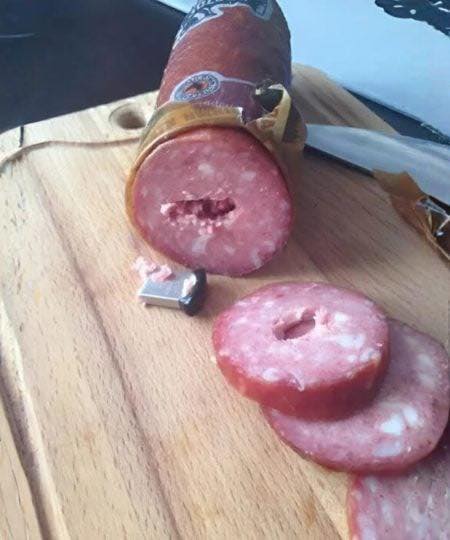
This bizarre story serves as a chilling reminder that digital secrets can be hidden in the most literal of ways. When a routine trip to the deli counter turned into a high-stakes mystery, one shopper discovered that some “ingredients” are better left untouched.
The Deli Secret: I Found a Flash Drive Hidden Inside a Sausage
This isn’t your average true-crime thriller. It’s a “recipe” for a modern-day mystery that began on a wooden cutting board and ended with a discovery that still haunts the person who found it. If you’ve ever wondered how far someone would go to hide a secret, this story is for you.
Prep Time: One Trip to the Local Market
Cook Time: 10 Minutes of Slicing
Yield: A Digital Discovery That Cannot Be Unseen
The Ingredients (The Setup)
1 Summer Sausage: A standard, vacuum-sealed deli meat purchased from a local grocer.
1 Sharp Kitchen Knife: Used for a routine snack preparation.
1 USB Flash Drive: Miraculously encased within the meat, protected from moisture and detection.
1 High-Stakes Secret: The data stored on the drive that was never meant to be found.
The Preparation (The Discovery)
It started as a quiet afternoon. I had pulled a summer sausage from the fridge, intending to make a simple charcuterie board. As the knife passed through the center of the meat, it hit something hard. Expecting a bone fragment or a gristle knot, I pulled the slices apart.
Instead of meat, I found a small, silver-and-black USB drive embedded directly into the center of the sausage. There was no sign of tampering on the outer casing, suggesting the device was placed there during the manufacturing or packaging process.
The Method (The Investigation)
Curiosity overcame caution. I cleaned the grease off the drive with a bit of rubbing alcohol and plugged it into an old “burner” laptop—one not connected to my home network.
The drive was titled “PROJECT_LUCID.” Inside were three main “folders”:
The Logistics Folder: Contained spreadsheets detailing delivery routes to major grocery chains, but with strange “drop-off” times listed in the middle of the night.
The Surveillance Folder: High-resolution photos of seemingly random families shopping in the very store where I bought the meat. Each photo was timestamped and labeled with a “Risk Level.”
The Audio Folder: A single, three-minute recording. It wasn’t music; it was a recording of a hushed conversation in a factory setting. One voice clearly stated, “If the batches are intercepted, the encryption will hold. They won’t know the source until the ‘activation’ is complete.”
The Secret Sauce (What Haunts Me)
The most terrifying part wasn’t the data itself, but the realization of the delivery method. Using a common food item as a “dead drop” for intelligence or illicit data is a tactic straight out of a Cold War playbook.
I realized that I wasn’t the intended recipient. This sausage was meant for someone else—someone who knew exactly which “batch” to buy. By slicing into my lunch, I had accidentally intercepted a communication channel for an organization that clearly monitored its customers.
The Finish (The Aftermath)
I didn’t call the police. I didn’t post the files online. After seeing my own grocery store listed in the “Logistics” folder, I realized the risk was too high. I destroyed the drive with a hammer and disposed of the pieces in separate bins across the city.
Chef’s Note on Digital Safety:
Never Plug in Mystery Drives: This story ended with a discovery, but it could have ended with a totally fried computer or a ransomware attack.
Trust Your Gut: If a food product feels “off” or contains a foreign object, report it to the manufacturer—but maybe don’t look too closely at what’s inside.
